
In the era of digital transformation, sustainability is no longer a buzzword. As mobile app development and software solutions proliferate, so does their environmental impact. Behind every line of code lies compute power, cloud storage, and data transfer - all of which consume energy and emit carbon. Fortunately, Low Code No Code Development is emerging not only as a faster and more cost-effective way to build applications but also as a greener alternative.
The Hidden Carbon Cost of Traditional Development
Traditional software development often involves large teams, long development cycles, continuous builds, and frequent testing, all hosted on servers that run 24/7. According to a 2020 study by Lancaster University, the global ICT (Information and Communications Technology) ecosystem contributes about 2-3.9% of global greenhouse gas emissions, with cloud computing and data centres being major contributors.
Consider this:
Developing a medium-scale app using traditional methods over 6 months can consume approximately 1,000 - 1,500 kWh of energy.
This is equivalent to 700 - 1,050 kg of CO2 emissions, roughly the same as driving a gasoline car for about 2,600 - 3,900 km.
Why Low Code No Code Development Is a Greener Alternative
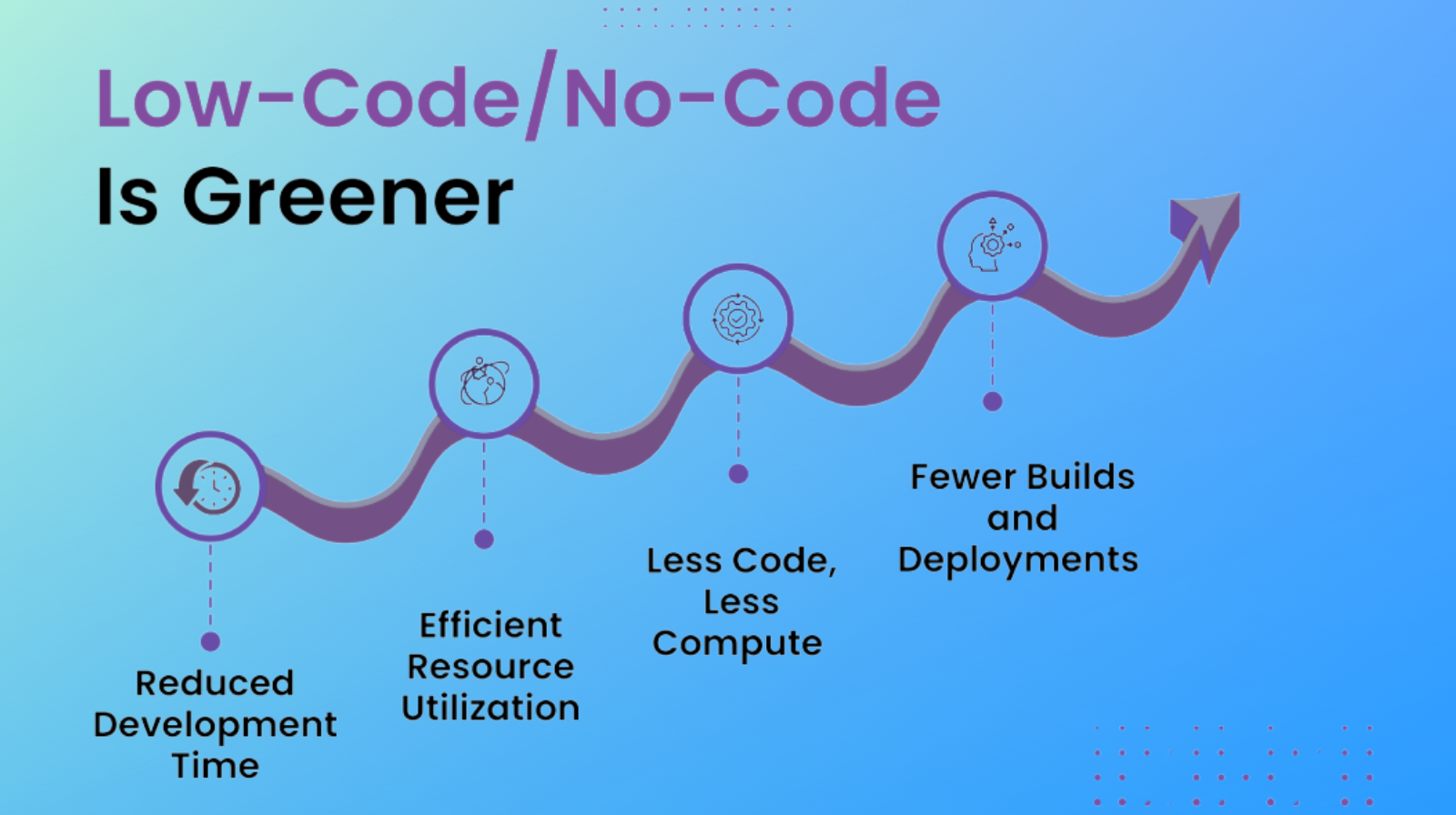
1. Reduced Development Time
Low code/No code platforms like Replit, Bolt, Glide, and Bubble allow apps to be built 3 - 10x faster than traditional methods.
Shorter development time means fewer compute resources used over time.
2. Efficient Resource Utilization
Low code/No code platforms are hosted in optimized cloud environments with auto-scaling and shared infrastructure.
Centralized environments reduce the energy cost per app by distributing the overhead.
3. Less Code, Less Compute
No heavy compilers, build pipelines, or custom backend servers.
Logic and processes are abstracted into reusable, energy-efficient components.
4. Fewer Builds and Deployments
Traditional DevOps involves CI/CD pipelines, build servers, and test environments that are often over-provisioned.
LC/NC workflows often eliminate this need, drastically reducing compute cycles.
Data-Backed Comparison: Traditional vs. LC/NC
Let's compare the carbon impact of a sample CRM application built using both approaches over a 6-month lifecycle:
Parameter | Traditional Development | Low-Code/No-Code |
|---|---|---|
Development Time | 24 weeks | 6-8 weeks |
Energy Usage (approx.) | 1,200 kWh | 300-400 kWh |
CO2 Emissions | ~840 kg | ~210-280 kg |
Server Instances Used | Dedicated VMs | Shared Cloud Resources |
Builds & Test Deployments | 100+ | 10-15 |
Beyond Carbon: Additional Environmental Benefits
Lower Hardware Turnover: With fewer resources needed, there's reduced demand for new hardware, decreasing e-waste.
Remote Work Enablement: Low code/No code platforms are often cloud-based, facilitating remote and distributed teams, which reduces commuting-related emissions.
Smaller App Footprints: Applications tend to be simpler and leaner, which reduces ongoing hosting and power consumption.
As we move toward a future where digital products play an important role in every industry, it’s necessary to consider their environmental impact. Sustainable low-code/no-code digital strategy is driving a productivity revolution. Adopting a Low Code No Code Development strategy enables businesses to innovate faster while significantly reducing their software carbon footprint. Combining this strategy with carbon footprint consultation helps create a greener tech ecosystem while still innovating at speed.